📌 Key Takeaways
- One logistics company cut 3–4 hours/day by reducing manual AP back-and-forth
- Load tenders reduced from 4 hours to 90 seconds (C.H. Robinson)
- 15,000 shipping-request emails/day processed, saving 600+ hours daily
- The 5 manual tasks: rate checking, document verification, status checking, invoice reconciliation, customs prep
- Most freight forwarder software starts after data is clean — the real pain is at intake
Still checking everything by hand?
You already know the answer.
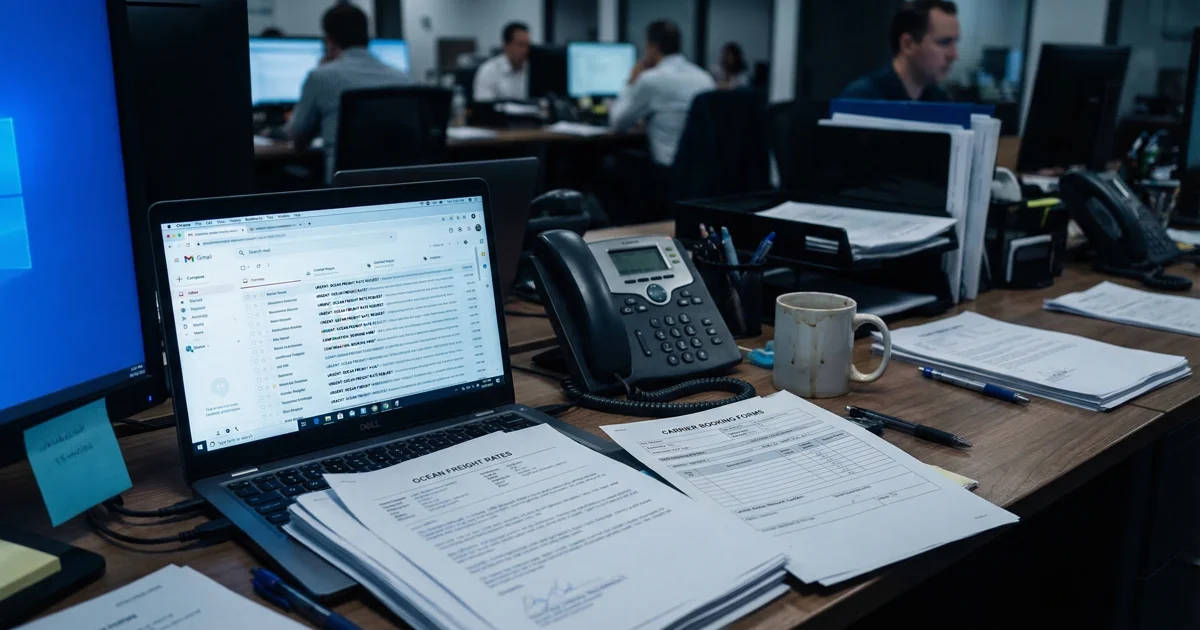
If you run ops in a freight forwarding team, you see the pattern every day: open the email, open the attachment, compare the rate, re-check the invoice, confirm the ETA again. Real freight forwarding automation does not start with dashboards - it starts with removing these daily manual checks.
Nobody in freight needs proof that manual checking exists.
What most teams miss is the real cost. The checking is spread across inboxes, attachments, follow-ups, and "quick reviews" that never look like one process. But together, they drain hours, slow replies, and create avoidable mistakes.
How much time disappears there every week?
How many delays get blamed on workload when the real issue is that the same shipment details are being reviewed three times in three different places?
That is where freight forwarding automation should start: not after the shipment is clean in the system, but at intake, validation, and exception handling.
You already know you are checking everything manually
Freight teams rarely call it "manual checking." They call it normal ops.
It is reading a rate confirmation line by line.
It is comparing a BOL to a POD to the customer instruction.
It is reopening the fifth arrival notice because ETA changed again.
It is reviewing an invoice that looked correct until someone spotted one bad charge.
Turing IT Labs describes the rate review process in a way most operators will recognize immediately: teams still "read, highlight, calculate, and rekey" while scanning rate sheets for mileage brackets, detention clauses, and fuel surcharge conditions line by line [Turing IT Labs]. That is not strategic work. It is repetitive verification.
Everyone knows this is happening.
The mistake is treating it as unavoidable overhead instead of margin leakage.
What manual checking actually costs your team
The numbers are not small.
FreightWaves reported that one logistics company cut 3 to 4 hours per day by reducing manual back-and-forth in AP and payment coordination [FreightWaves]. That is half a workday recovered.
The Loadstar reported that operators may receive five or more arrival notices per shipment, with about 10 minutes per pre-alert spent re-checking ETA, IT number, pickup number, and location [The Loadstar, snippet]. That can turn one shipment into nearly an hour of repeated checking.
C.H. Robinson said load tenders once took up to 4 hours before being reduced to 90 seconds in its email-to-action flow [C.H. Robinson]. A LangChain partner writeup on the same program said CHR processed 15,000 shipping-request emails per day and saved 600+ hours per day after cutting work that had taken around seven minutes per email [LangChain/CHR].
Then there is the error cost.
FreightWaves says manual invoice auditing regularly uncovers duplicate charges, incorrect rates, misclassified freight, and unauthorized fees [FreightWaves]. Those are not rare mistakes. They are what happens when teams compare too many documents by eye under time pressure.
And once that load builds up, the damage spreads:
- slower invoicing
- slower carrier payment
- billing disputes
- lost capacity
- frustrated customers
If your best people are always checking, what are they not getting done?
Dealing with the same challenge?
Book a free 30-min call — we'll map your email workflow together.
Book a Free Call →The 5 tasks forwarders still do by hand (and shouldn't)
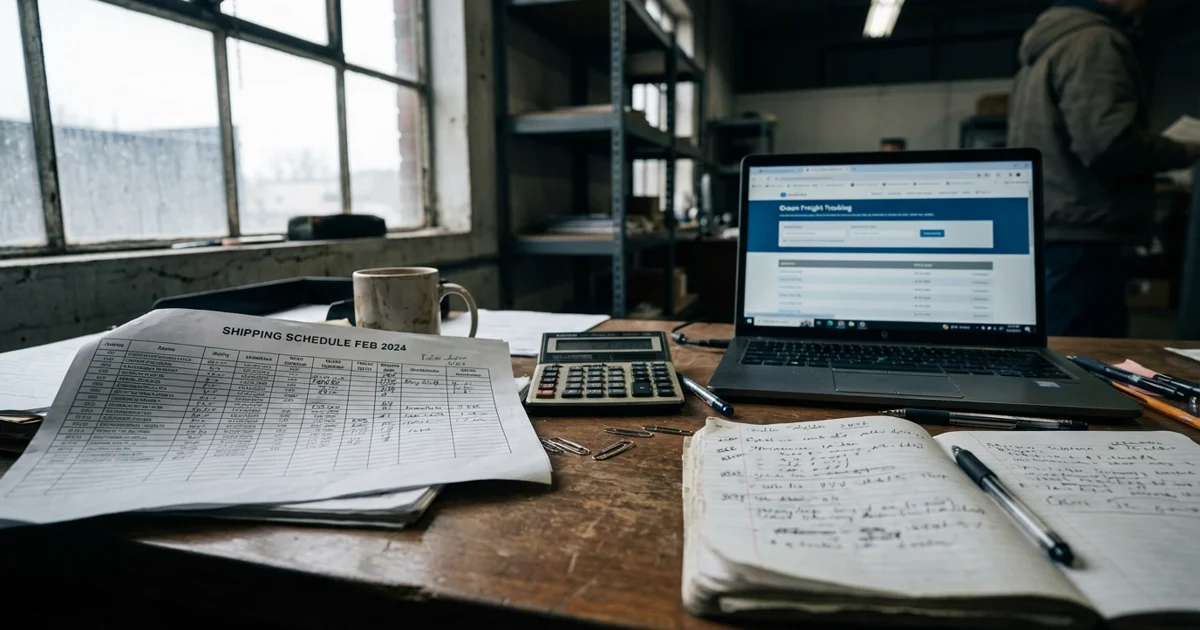
1. Rate checking
Read the quote. Highlight the right charge. Calculate the condition. Compare against the agreement. Rekey into another file or message.
Turing IT Labs summed up this pattern as "read, highlight, calculate, and rekey" [Turing IT Labs]. Most forwarders still have someone doing exactly that.
2. Document verification
Does the BOL match the POD?
Does the contract match the shipment instruction?
Are there missing signatures or quantity mismatches?
FreightWaves, citing Hyperscience, says completeness checks can flag missing signatures, unsupported accessorials, and quantity mismatches in real time [FreightWaves/Hyperscience]. Products exist because these errors are common.
3. Status checking
Customers ask for ETA. Carriers send revisions. Teams reopen the same thread to confirm whether cargo is released, delayed, or ready for pickup.
The Loadstar example of five or more arrival notices per shipment shows why this becomes a serious drag [The Loadstar, snippet].
4. Invoice reconciliation
Ops checks one thing. Finance checks another. AP asks for confirmation. Someone compares the invoice to the rate card, then to the shipment file, then back to the contract.
FreightWaves identified duplicate charges, wrong rates, and misclassified freight as common findings in this process [FreightWaves].
5. Customs preparation
This one hits harder in Dubai.
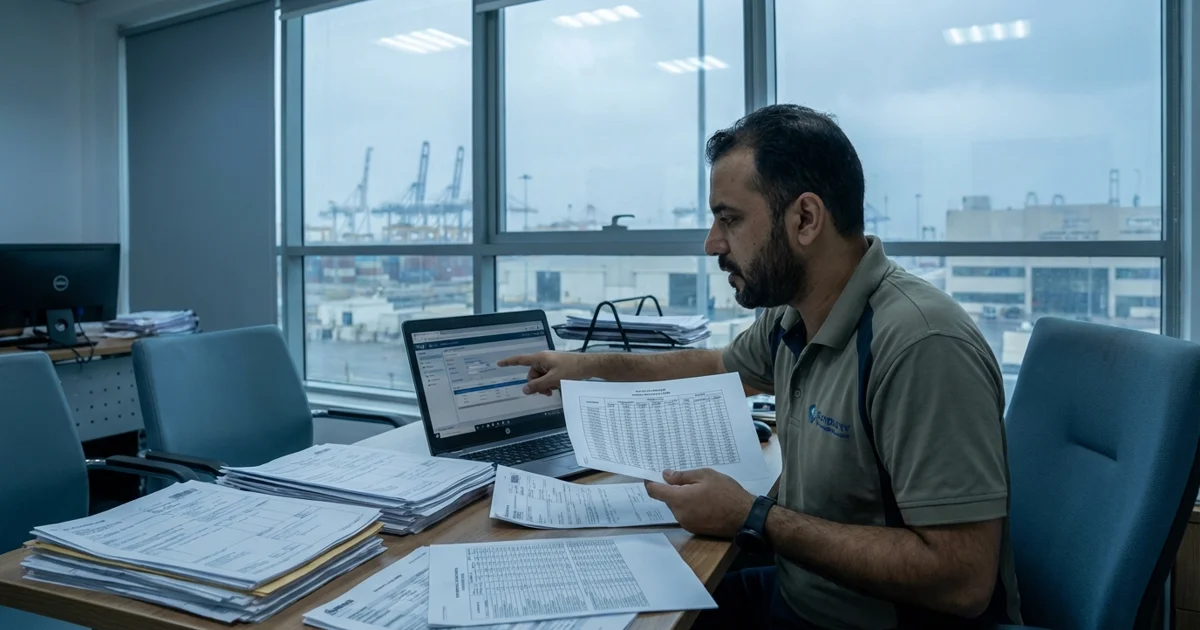
HS code review, customs value checks, business code verification, restriction status, temporary admission deposits. None of it is optional, and much of it still arrives in mixed formats from different parties.
Why most freight forwarder software does not fix this
A lot of freight forwarder software is useful. But most of it starts working after the data is already clean enough to enter the system.
That is the gap.
The painful checking usually happens:
- before the record is created
- while documents still arrive by email
- when details conflict across attachments
- when exceptions do not fit a clean template
A TMS is strong once the workflow is structured.
It is not where messy intake begins.
The inbox is where the friction starts: a quote request, a revised notice, a scanned attachment, or an invoice with one wrong field. The system of record comes later.
So when teams ask, "We already have software. Why are we still checking everything manually?" the honest answer is simple: because freight forwarding automation needs to work at the intake layer — before and around the system, not neatly inside it.
🔧 Quick Win: 3 checks you can stop doing manually today
Not every improvement needs a big project.
Start with the checks that repeat in the same pattern every day.
1. Standard confirmations
If your team keeps sending the same booking-confirmed, docs-received, or waiting-for-approval replies, use controlled templates with clear triggers.
That will not remove every exception.
It will remove the repeat work.
2. Rules-based document routing
If the POD always goes to one queue, invoices to another, and missing-signature documents to a review lane, stop making people triage the same files manually.
FreightWaves reported that intake tools like Hyperscience classify, extract, and validate documents at intake with cross-document matching and contract-driven rules [FreightWaves/Hyperscience]. The principle matters more than the vendor: route first, review second.
3. Batch status updates
If operators are still checking shipment status one by one, move standard updates into batches and escalate only the exceptions.
The Loadstar's arrival-notice example shows why per-shipment checking becomes a trap [The Loadstar, snippet].
⚡ Advanced: What real freight forwarding automation looks like
Real change does not mean removing humans from freight.
It means removing humans from pure repetition.
The strongest examples are already visible.
FreightWaves reported that Hyperscience helps automate 80% to 90% of routine loads by classifying, extracting, validating, and matching freight documents at intake [FreightWaves/Hyperscience].
C.H. Robinson said it automated more than 10,000 routine transactions per day, with load tenders reduced from up to 4 hours to 90 seconds [C.H. Robinson]. The LangChain partner writeup adds the scale behind that shift: 15,000 emails per day and 600+ hours saved daily [LangChain/CHR].
super.AI reported 85% of freight BOL processes automated and a 95% reduction in data errors in one medical-products case [super.AI]. Freightmate says document workflows can free 2+ hours per shipment [Freightmate]. Cozentus reported about 10,000 man-hours per month saved and roughly 80% less manual effort in freight invoice audit work [Cozentus].
The pattern is consistent:
- intake gets handled faster
- documents get matched earlier
- exceptions get surfaced sooner
- people work edge cases, not the whole pile
That is where Quantika fits: the inbox layer where the manual checks start.
Dubai: where manual checking hits harder
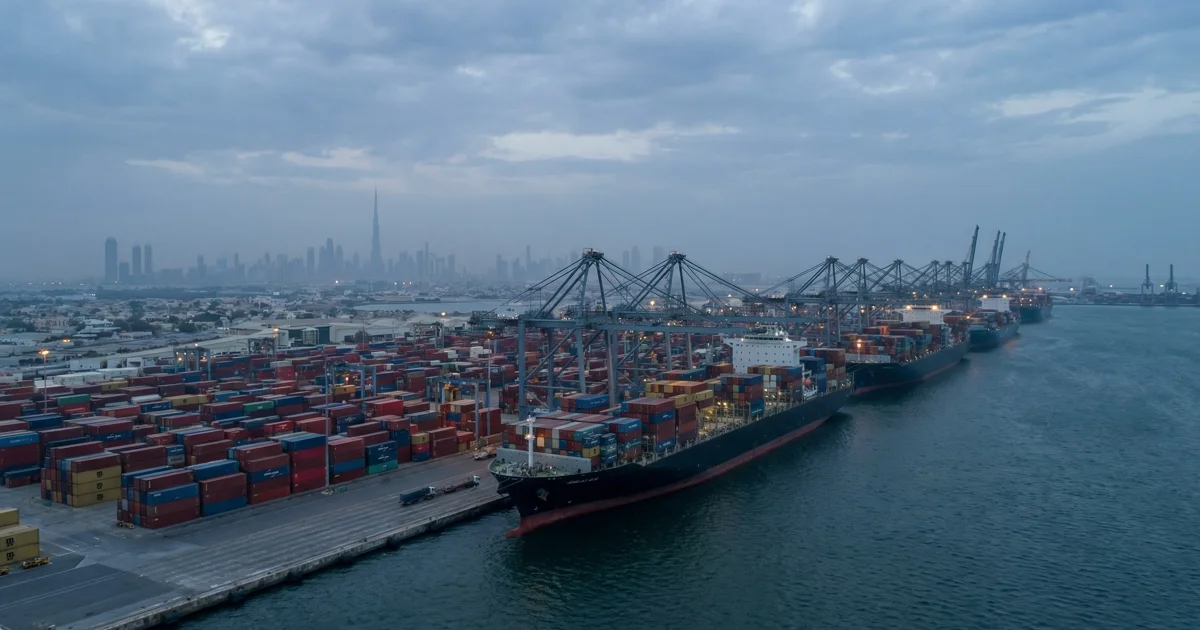
Dubai adds more pressure because teams are not only checking commercial details. They are often checking customs readiness too.
Dubai Customs says a license holder should obtain a Customs Business Code and submit declarations using that code; agents also need authorization from the cargo owner when clearing on their behalf [Dubai Customs]. Dubai Customs guidance also says the commodity system shows the duty rate and any prohibition or restriction status for each item [Dubai Customs / Al Munasiq]. And when customs officers doubt the truth or accuracy of a declaration, importers may be asked for more clarification and supporting evidence [Dubai Customs].
That means a bad manual check is not only an internal ops problem.
It can become a customs delay, a valuation dispute, or a release issue.
The goal is not full automation - it's removing the unnecessary manual
Freight will never be one-click clean.
There will always be exceptions. There will always be shipments that need judgment.
That is not the problem.
The problem is forcing experienced people to spend the day re-reading, re-checking, and re-keying routine details that should have been handled earlier.
The goal is not full freight forwarding automation. It is removing unnecessary manual work where it adds no value.
If your team is still checking rates line by line, reopening the same arrival notices, comparing invoices by eye, and chasing document mismatches through the inbox, the opportunity is already in front of you.
See how Quantika handles the manual checks your team shouldn't be doing.